Two agents that take any disease from data to a drug program — and a manuscript.
The molecules on this site are demonstrations. The real deliverable is the engine that produced them: a pair of human-in-the-loop AI specialists that a non-coding scientist can point at any disease. Part 1 turns a disease into a full, decision-gated drug-development program. Part 2 turns that program into a written, peer-review-style manuscript. Together they take one person from “here is a disease” to a program and the paper that documents it — the same path this site walked three times, across two diseases.
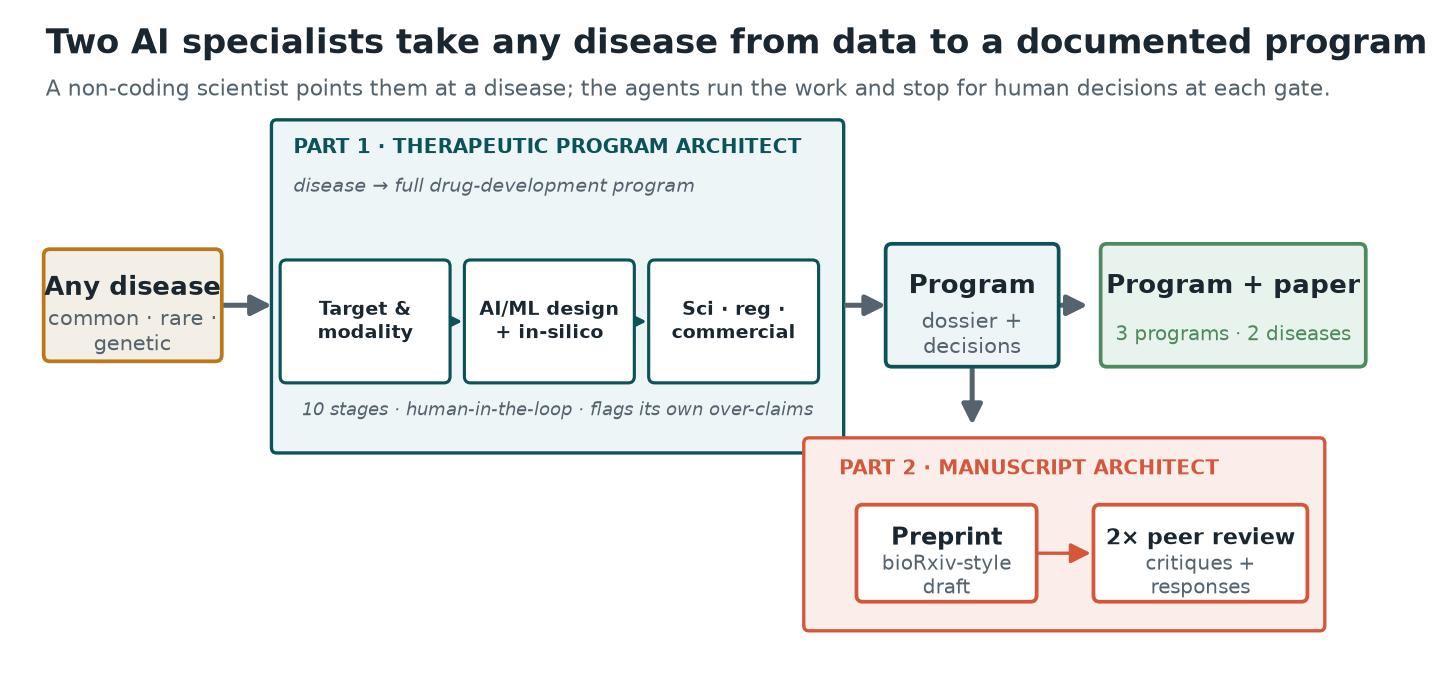
Why it matters. I am one person, living with the disease I started on, and I do not write production code. In one week these two agents let me run a credible, honest, end-to-end drug-discovery program — and then generalize it to a second disease I have no personal stake in. That is the case: not a single result, but a repeatable, inspectable method that puts a full program within reach of any motivated researcher or patient community.
The Therapeutic Program Architect
Give it any disease — common, rare, or genetic — and it runs a ten-stage, human-in-the-loop program: from unmet need and patient priorities, through data- and literature-mined target and modality selection, AI/ML design and in-silico pressure-testing, to scientific, regulatory, and commercial strategy. It stops and asks you at every consequential decision, and it flags its own over-claims.
- Indication & unmet need Epidemiology, biology, standard of care, and precedent.
- Patient priorities / PFDD What patients actually want fixed — with an optional community survey.
- Literature + competitive pipeline Mechanism map plus who is developing what, and why they succeeded or failed.
- Data mining → targets Omics meta-analysis and single-cell → ranked druggable targets.
- Target & modality selection The pivotal fork: a scored rubric, then you confirm the pick.
- Design & pressure-test Modality-routed AI/ML design plus in-silico validation.
- Scientific development plan AI-to-first-in-human assay cascade, CMC, biomarkers.
- Regulatory strategy FDA / EMA path, designations, endpoints.
- Commercial & financing TAM/SAM/SOM, whitespace, financial model, and the Ask.
- Deliverables & synthesis Business plan, scientific plan, deck, manuscript, peer review.
The Manuscript Architect
A program is only useful if others can read, check, and build on it. The Manuscript Architect turns a completed program dossier into a structured, bioRxiv-style preprint — then hardens it through two rounds of synthetic peer review, generating reviewer critiques and point-by-point responses so the weak claims surface before a human reviewer ever sees them.
Dossier → preprint
Assembles the program's targets, designs, methods, and figures into a complete manuscript with the sections and rigor a preprint server expects.
Two rounds of synthetic peer review
Generates independent reviewer critiques and the author responses to them — a self-correcting loop that catches over-claims and gaps early.
Honest by construction
Every computational result is labeled in-silico, never “validated.” The honesty line is enforced in the writing, not bolted on afterward.
The three manuscripts on this site were produced this way — read them →
One engine, three programs, two diseases
The same two agents produced every program on this site. The clearest evidence that the method generalizes is that it re-ran cleanly on a disease with entirely different biology and a different modality.
pMHC-II antigen engine
Personalized antigen selection for eosinophilic esophagitis — 4,640 peptide×allele evaluations → 832 strong binders.
CCL26 / POSTN binders
A 9-cohort meta-analysis to two no-trial targets, then 80→1,920→60 de novo designs with an honest negative-control calibration.
GUCY2C / DKK1 dual arm
The generalization test: public genomics → two nominated targets → 16 binders, 15/16 clearing the interface line.
Both agents are open
Both specialists and the skills behind them are public, installable, and reproducible — part of twelve open repositories spanning target mining, epitope mapping, protein design, patient-org navigation, market analysis, peer review, and media.