Steering into whitespace: a dual-arm program for esophageal cancer.
To test whether the pipeline behind Project Tolera was specific to EoE or genuinely disease-agnostic, I pointed the same engine at a very different problem — esophageal adenocarcinoma (EAC) and its precursor, Barrett's esophagus. Starting from public genomics and the competitive trial landscape, it nominated two targets and delivered de novo binder leads for each: a GUCY2C T-cell-engager for established cancer, and a DKK1 neutralizing trap to intercept the Barrett's→cancer transition. Same method, second disease.
The full pipeline ran end-to-end on EAC: it generated the same program documents — scientific, regulatory, and commercial — plus a peer-review-hardened manuscript, exactly as it did for Project Tolera.
Why this page exists. Esophageal adenocarcinoma is personal — I lost my father to it — and it is also the generalization test. This is not a second company: Project Tolera is the deep, patient-voice-first EoE program, and this page is the proof that the underlying engine re-runs on a different disease, biology, and modality without hand-tuning. Choosing EAC was not arbitrary; the two disease pages reference each other by design.
A copy-number-driven cancer with a crowded immune-checkpoint corner
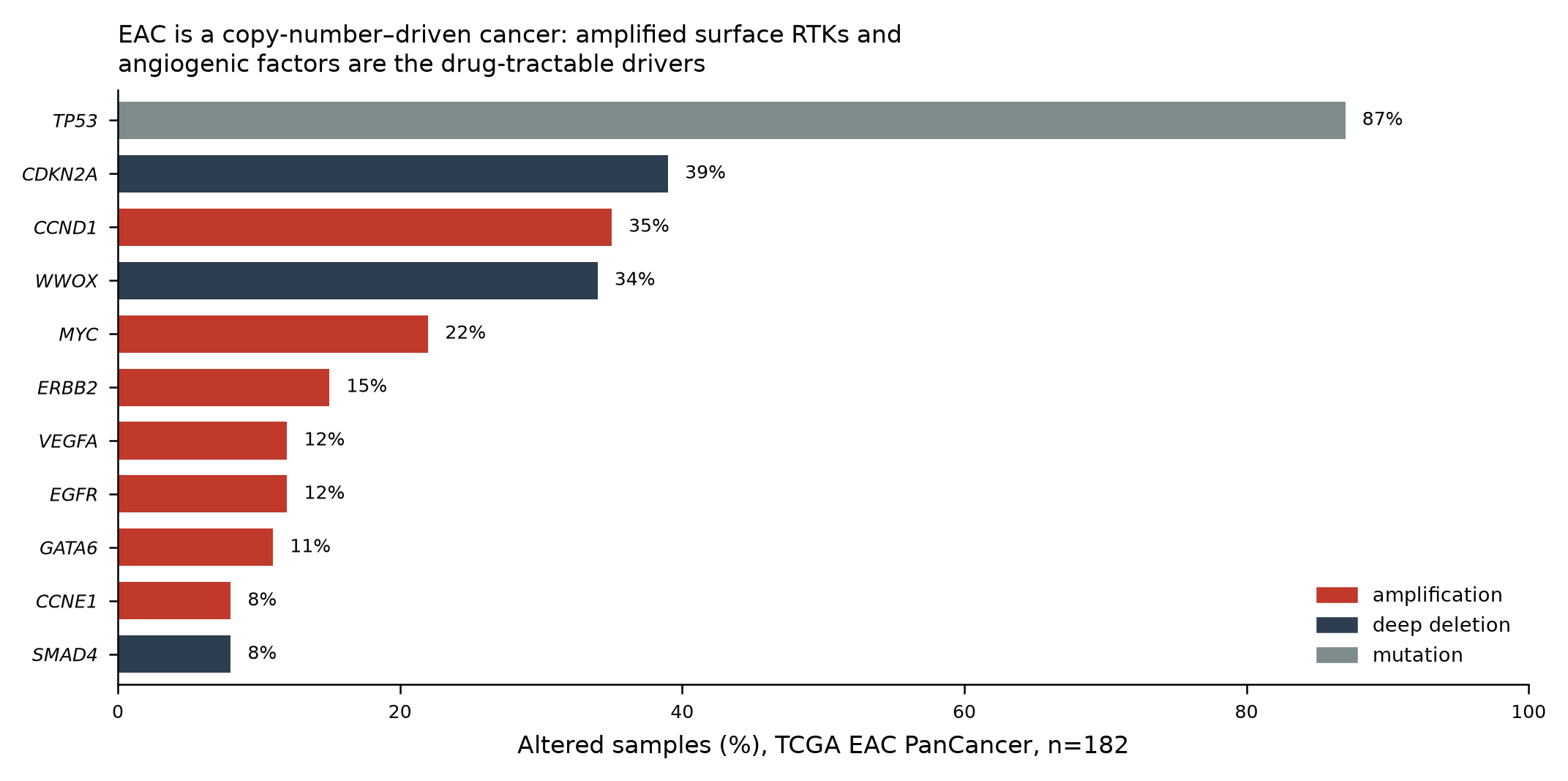
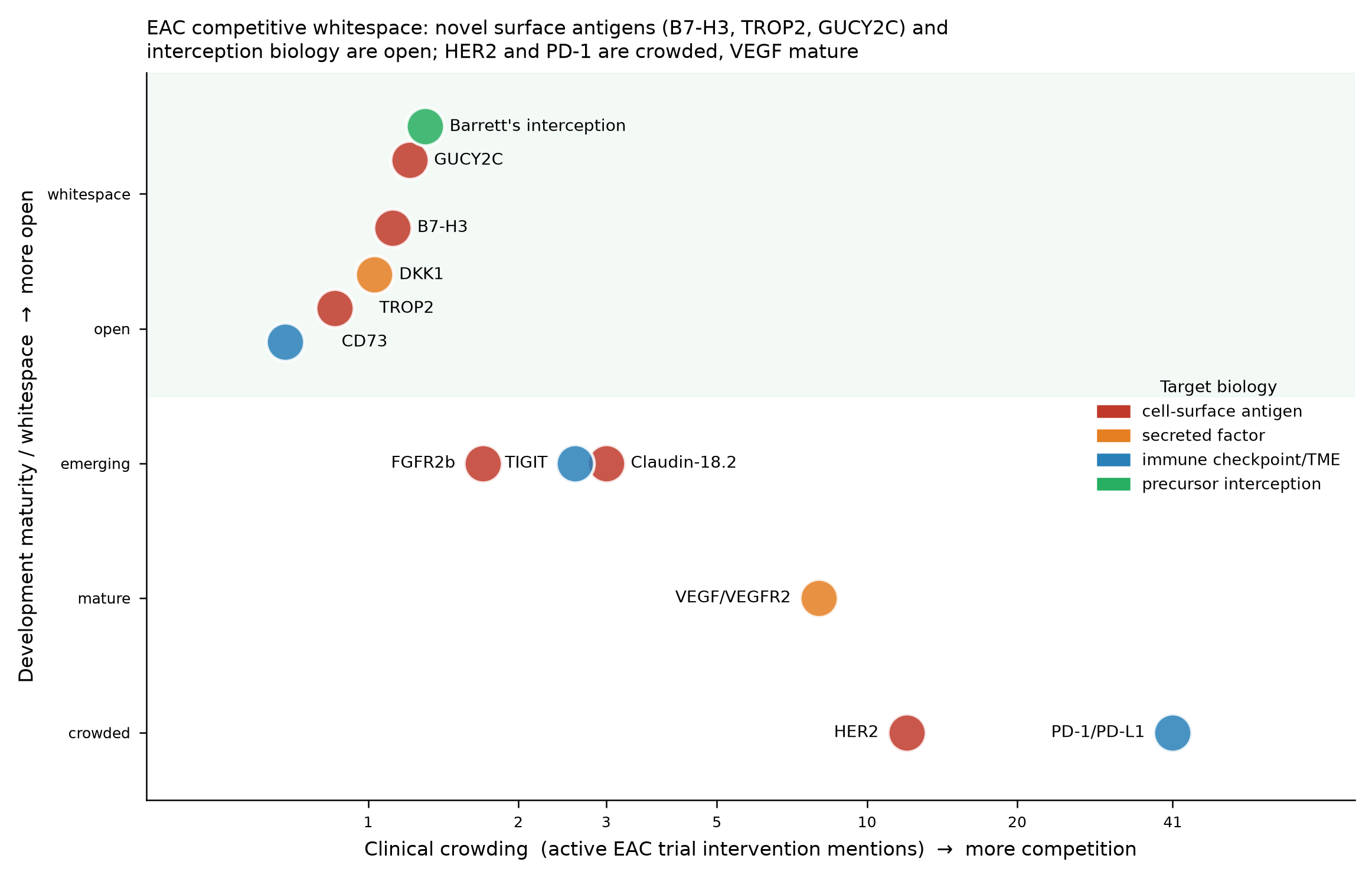
Public genomics from TCGA/cBioPortal (esca cohort, n=182) show EAC is dominated by copy-number change rather than druggable point mutations — TP53 altered in 87%, CDKN2A deleted in 39%, CCND1 amplified in 35%. Against 351 interventional EAC trials (106 active), most cluster around the same checkpoint and HER2 mechanisms. The engine triaged 16 candidate targets and nominated two that sit in open space.
Treat the cancer, and intercept the transition to it
GUCY2C T-cell engager
GUCY2C is a cell-surface receptor with GI-restricted normal expression, retained in a large fraction of GI adenocarcinomas — a handle for a T-cell-engaging biologic in established EAC. The engine ranked it first among the triaged targets and designed de novo binders against it.
Make-or-break question: the normal-gut therapeutic window. Named as an open question in the manuscript.
DKK1 neutralizing trap
DKK1 is a secreted Wnt modulator implicated in the Barrett's→dysplasia→EAC progression. A neutralizing trap offers a route to intercept the transition in high-risk Barrett's patients rather than only treating cancer once it forms.
Make-or-break question: a dysplasia-regression surrogate endpoint. Named as an open question in the manuscript.
16 binders designed, 15 of 16 clear the interface line
Eight backbones per target were carried through the same design-and-gate pipeline used across the other programs. 15 of 16 cleared the ipTM > 0.5 interface threshold; the leads are a GUCY2C binder at ipTM 0.915 and a DKK1 binder at ipTM 0.858. As everywhere on this site, these are computational structure predictions — leads to test, not validated binders.
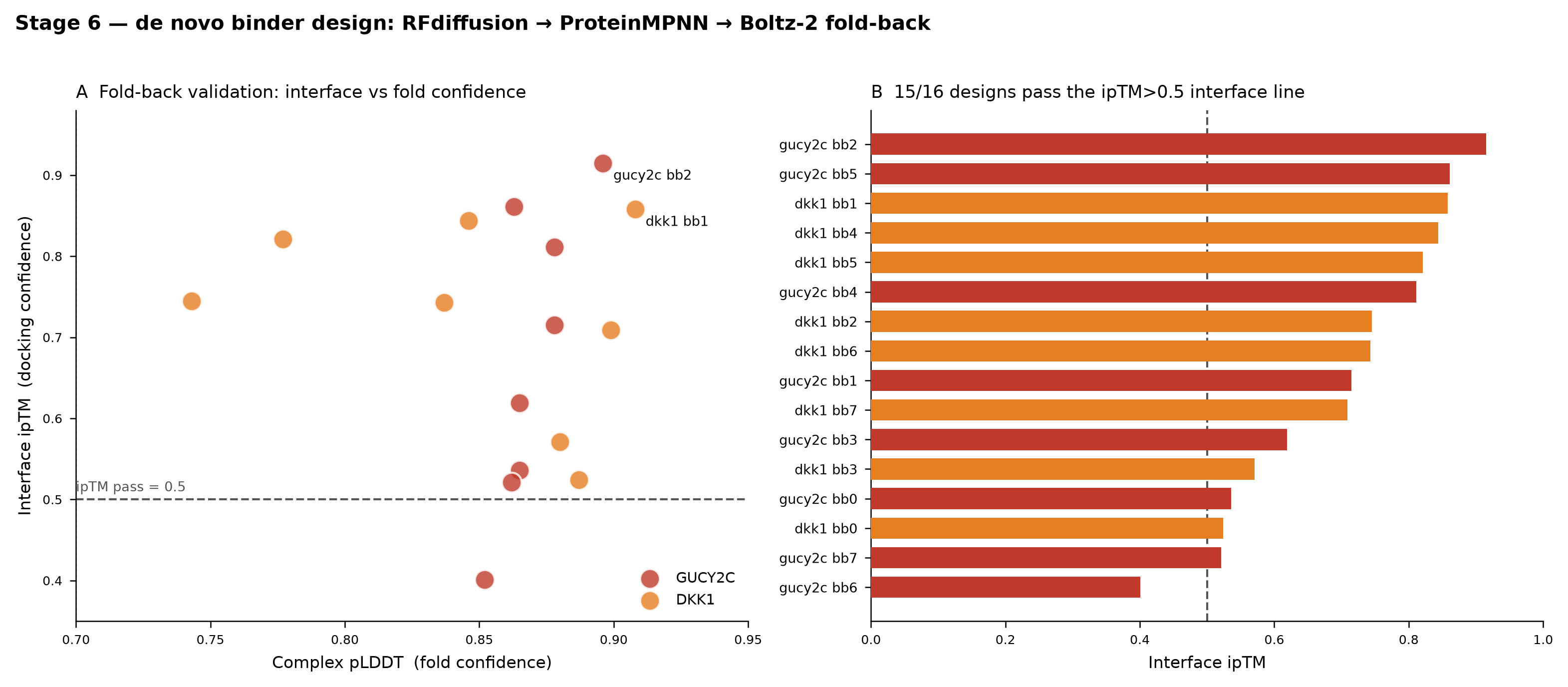
gucy2c_bb2 at ipTM 0.915
(flagged for a high-alanine developability liability); DKK1 lead dkk1_bb1 at ipTM 0.858, the
cleanest of the set. 15/16 designs clear the interface line.Program verdict: TRACTABLE (0.87). The dual-arm program is judged tractable, with two named make-or-break questions — the GUCY2C normal-gut window and a DKK1 dysplasia-regression surrogate endpoint — that would gate any real-world development. Everything here is in-silico and not experimentally validated.
Manuscript & structures
The full dual-arm manuscript and the two lead complexes are downloadable. The manuscript sits alongside the EoE work on the manuscripts page.
Dedicated to my father, Patrick Langan (1946–2017).